3 min read
Rippletide and Baseten Sandboxes partner for trustworthy AI agents
Rippletide checks each AI agent action against business rules and current facts. Baseten Sandboxes then run the approved code in an isolated microVM.

An agent that writes and runs code needs two safeguards. It must pick the right action, and that action must run in a contained environment. Rippletide partnered with the team behind what are now Baseten Sandboxes to cover both. The team has since joined Baseten.
Rippletide checks each proposed action against explicit business rules and current facts. Every verdict carries evidence, the applicable rule, an outcome, and a reason. Baseten Sandboxes then run the checked code, each sandbox in its own microVM with no shared kernel.
Key takeaways
- Rippletide checks each proposed agent action against business rules and current facts, and every verdict carries a reason.
- Rippletide's hallucination-free-by-design claim covers its decision layer only, not free text an upstream LLM generates.
- Baseten Sandboxes run approved code in microVMs with no shared kernel and resume from standby in under 25ms.
- Sandbox isolation covers executed code from the first run, while Rippletide's checks move from Observe to Enforce.
Building secure, trusted enterprise agents
The partnership with Rippletide combines decision checks with isolated code execution.
Teams building enterprise agents that execute code face separate concerns. Decisions must be reliable, and execution must be fast and isolated.
Rippletide first described its product as a hypergraph database that combines memory and reasoning to reduce agent hallucinations. The company now calls itself the Action Runtime for enterprise AI agents.
The runtime decides whether each proposed action should take effect. Baseten Sandboxes are the infrastructure foundation for autonomous agents, with isolated compute for code that agents run in production.
Rippletide's "hallucination-free by design" claim applies to its decision layer. In that layer, decisions come from explicit facts and deterministic rules outside the model. The claim doesn't cover free text an LLM generates upstream.
A follow-up article responding to a Rippletide post explains why teams need both layers: "A sandbox lets the agent act. A decision layer helps it act correctly."
The two layers split the work like this:
| Layer | Provider | What it handles | Outside its scope |
|---|---|---|---|
| Decision | Rippletide | Returns a verdict on each proposed action | Upstream LLM output |
| Execution | Baseten Sandboxes | Runs the approved action's code in its own microVM | Whether the action itself is correct |
Fast, isolated execution for checked actions
Spinning up a fresh container or VM for every task is expensive and can add seconds of latency. Rippletide's launch announcement used sales-assist tools and live support bots as examples. For those real-time uses, an 800-millisecond delay could break the experience.
Baseten Sandboxes are agent-native compute environments that can be created in under a second. Sandboxes persist state in standby across sessions. They resume from standby in under 25ms.
Teams also get real-time debugging and observability. For Rippletide-powered agents executing arbitrary code, Baseten Sandboxes provide microVM isolation. Each sandbox runs with no shared kernel. As a result, AI-generated code can't reach the host kernel used by other workloads. Baseten Sandboxes hold SOC 2 Type II, HIPAA, and ISO 27001.
In the pattern the two partners describe, each proposed action follows this path:
- The agent proposes an action, such as a tool call, a code patch, or a refund. Rippletide's launch announcement puts it this way: "Before any action is executed on Blaxel's infrastructure, the agent traverses Rippletide's decision graph to verify that the action complies with every applicable rule."
- Rippletide returns a verdict and its reason. Continue lets the action proceed, and Needs a person escalates it. In Observe mode, Rippletide flags rule matches for review but blocks nothing. In Enforce mode, Must stop blocks the action before the tool runs.
- Actions that proceed run their code in an isolated Baseten Sandbox.
Rippletide decides whether an action should run. Baseten Sandboxes contain the code once it does.
Two setup paths: the Quickstart or the Python template
The Rippletide connection workflow has changed since launch. The Baseten Sandboxes Rippletide integration guide now points new projects to Rippletide's official Quickstart. The Quickstart's CLI setup supports JavaScript and TypeScript agents, plus Model Context Protocol (MCP) servers. The Quickstart isn't a drop-in replacement for the Python template.
The customer support agent template is the Python example, powered by Rippletide's hypergraph database:
- Clone the template repository and install its dependencies.
- Add your Rippletide API key to the
.envfile. Then copyagent_config.json.exampletoagent_config.jsonand add your company's Q&As, tool calls, and guardrails. - Run
uv run src/setup_agent.py agent_config.json --pdf knowledge.pdfto create a Rippletide agent. Then add the resulting agent ID to.env.
On either path, follow the rollout order in Rippletide's starter kit. The kit advises: "Start in Observe, review real matches, then deliberately enable Enforce on the releases you trust."
Pair decision checks with isolated execution
The two layers can roll out on different schedules. Sandbox isolation covers all executed code from the first run, while Rippletide's checks move from Observe to Enforce. Teams can also evaluate other sandbox providers for the execution layer. Setup steps for that layer are in the Baseten Sandboxes documentation.
FAQs about Rippletide
What is Rippletide?
Rippletide is a company based in Paris and San Francisco that builds decision infrastructure for enterprise AI agents. Its Action Runtime checks proposed actions against business rules and current facts before they take effect.
Does Rippletide stop AI agent hallucinations?
Rippletide calls its decision layer hallucination-free by design. The label covers only that layer and excludes text an upstream LLM writes.
How do Rippletide and Baseten Sandboxes work together?
For coding agents, the decision layer runs as a pre-tool-call hook before any tool executes. Blocked actions never reach execution. Allowed actions then execute inside a Baseten Sandbox.
Related articles
Blaxel News
Securing the open frontier with NVIDIA OpenShell and Blaxel sandboxes
Baseten is a launch partner for the NVIDIA Agent Safety Platform and supports OpenShell in the latest generation of Blaxel Sandboxes.
4 min read
Blaxel News
How to Combine Sandbox Safety with a Decision Layer That Gets the Job Done
Sandboxes let coding agents act safely. Decision layers make sure they act correctly. How Blaxel and Rippletide think about combining both.
5 min read
Blaxel News
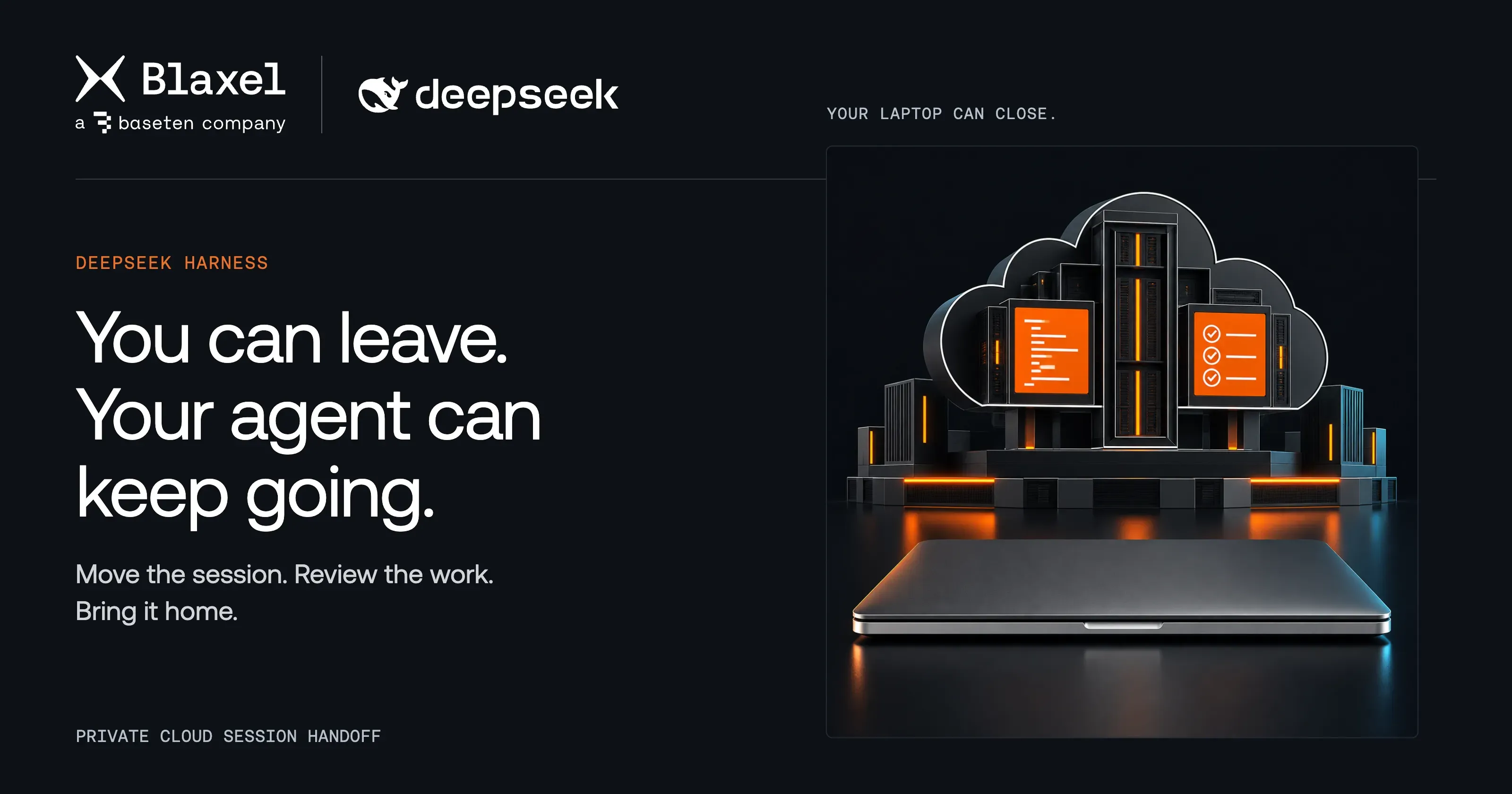
Close your laptop. Keep DeepSeek Harness working on Blaxel.
Take your DeepSeek Harness task to a private Blaxel host and let it keep working. Review the patch, then return the files and conversation to your computer.
4 min read