2 mins
Your agent is only as fast as its slowest bottleneck
Blaxel was the only provider ranked in the top two across all six headline performance metrics in StarSling's July 23 sandbox benchmark.

A coding agent depends on CPU, disk, memory, and networking at different points in a task. Whichever resource is slowest sets the pace.
That bottleneck can move several times in one run. Cloning leans on the network and filesystem. Installing packages adds CPU, random I/O, and metadata operations across thousands of files. Type checks and builds change the mix again.
A first-place result in one test tells you where a provider is strong. It does not tell you where the agent will get stuck.
StarSling's open-source benchmark is useful because it tests six different dimensions on the same requested configuration: 4 vCPU, 8 GiB of RAM, and 40 GB of disk. Its July 23 run contains 255 metric records backed by 2,533 retained trial observations.
The leaderboard publishes one headline metric for each measured performance dimension:
| Performance dimension | Headline metric | Blaxel rank |
|---|---|---|
| CPU | Node.js web tooling | 1 |
| Disk | fio random read, 4 KB O_DIRECT | 1 |
| Memory | STREAM Triad | 2 |
| Networking | iperf3 loopback TCP, one stream | 2 |
| System | PyBench | 2 |
| Real-world workloads | Mastra cold install | 2 |
| We ranked first on the CPU and disk headline metrics and second on memory, networking, system performance, and real-world workloads. We were the only provider in the top two across all six. |
Different providers led different workloads, and several headline comparisons use small samples.
For teams building coding agents, app generators, QA agents, and agentic developer tools, every runtime bottleneck becomes product latency.
In StarSling's run, we had no headline performance dimension below second. That consistency matters because the workload shifts between resources as the task progresses.
Related articles
Blaxel News
Securing the open frontier with NVIDIA OpenShell and Blaxel sandboxes
Baseten is a launch partner for the NVIDIA Agent Safety Platform and supports OpenShell in the latest generation of Blaxel Sandboxes.
4 min read
Blaxel News
How to Combine Sandbox Safety with a Decision Layer That Gets the Job Done
Sandboxes let coding agents act safely. Decision layers make sure they act correctly. How Blaxel and Rippletide think about combining both.
5 min read
Blaxel News
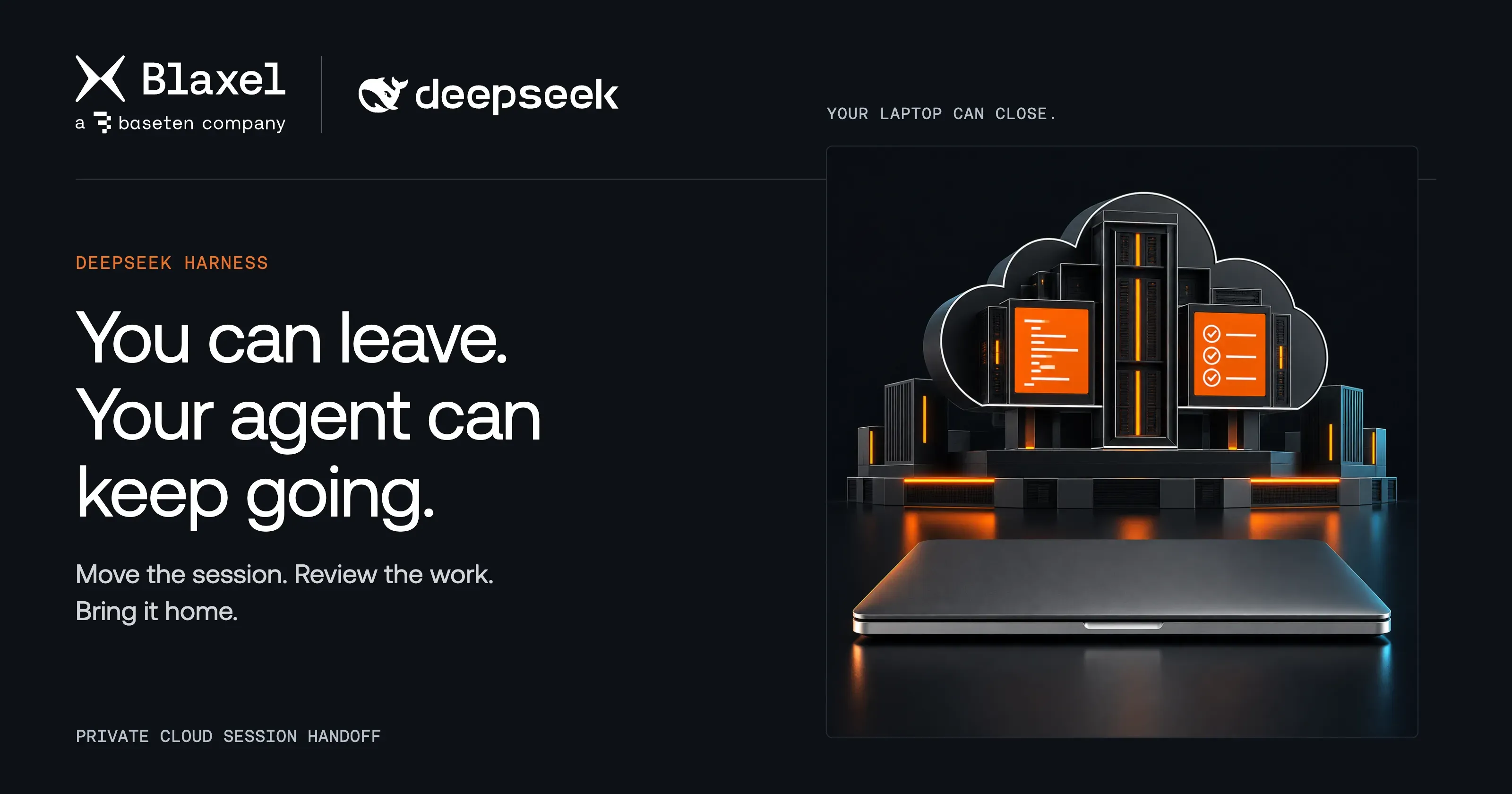
Close your laptop. Keep DeepSeek Harness working on Blaxel.
Take your DeepSeek Harness task to a private Blaxel host and let it keep working. Review the patch, then return the files and conversation to your computer.
4 min read