
[SHARED FILESYSTEM FOR AGENTIC WORKLOADS]
A shared memory layer for AI agents
Many agents, one drive
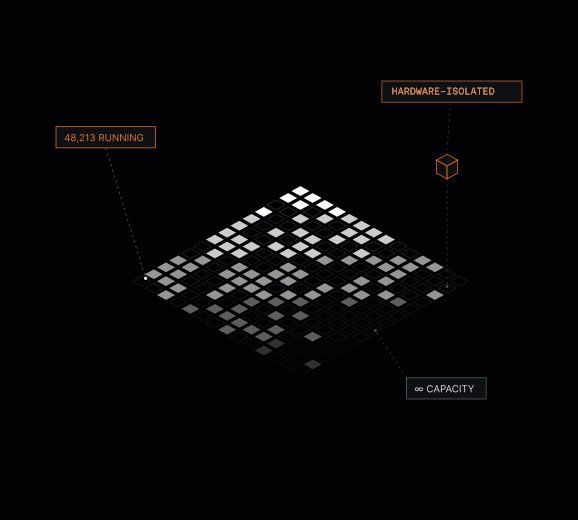
Concurrent read-write access from multiple sandboxes at once, so a fleet of agents can work on the exact same files.
Mount as a path
A POSIX-compliant FUSE client makes a drive appear as a normal directory inside every sandbox that mounts it.
Bottomless storage
Drives grow automatically with no fixed capacity limit. Nothing to pre-provision.

[BUILT FOR TRILLIONS OF AGENTS]
A filesystem, not an object store
Object storage such as S3 was not designed for POSIX operations, or for the many-small-files pattern of agentics. Agent Drive is built as a filesystem from the ground up, designed to hold trillions of files and keep every read fast.
O(1) reads
Reading a file costs a single disk seek, however many files the drive holds.
Small-file optimized
Designed for the patterns of agentic workloads: many small reads and writes at very high concurrency.
Custom FUSE client
An optimized, POSIX-compliant FUSE client runs in every sandbox, developed in-house for agent workloads.
Scale-out by design
Metadata and file content scale independently and horizontally, so a drive grows without re-sharding.
Built-in replication
Data is replicated across nodes, so a drive stays durable and readable through node failures.
Faster than S3
Agent Drive is 5–10x faster on small-file I/O than object-storage-based filesystems.

“Blaxel Agent Drive is 5-10x faster than the S3-based filesystem solution we had previously implemented.”

[FINE-GRAINED DATA ACCESS CONTROL]
Share the drive, but not every file
Label-based rules
Match on workload identity labels such as team=backend or env=prod.
Read or read-write
Set a mode per rule, so one agent writes while another only reads.
Path scoping
Confine a workload to one folder, such as /reports, or even one file.
Update rules live
Change permissions on a drive that is already in use.

[S3-COMPATIBLE ENDPOINT]
Reach your drives from outside Blaxel
Standard S3 clients
Point any S3-compatible tool at the drive's endpoint, with path-style addressing.
SigV4 authentication
Requests are SigV4-signed with a service account's API key, using path-style addressing.
Seed and collect data
Load datasets before agents start, and pull their results into your own pipelines.
[PURPOSE-BUILT FOR AGENTS]
Build a shared memory layer for your agents
Handoff of small files
Agents produce many small files: notes, JSON artifacts, tool outputs. Agent Drive is tuned for this access pattern, with high concurrency and no serialization step in between.
Shared memory
Keep long-term agent context, conversation history, and accumulated knowledge across sessions. New sandboxes mount the drive and pick up where previous ones left off.
Dependencies
Put code dependencies or datasets on a drive. Every sandbox that mounts it gets immediate access without downloading them again.
Parallel agents
Fan out work to dozens of sandboxes running in parallel, each writing results to the same drive. A coordinator agent reads the aggregated results when the workers finish.